Plan · Transit & Streets
Transit & Streets
Signature policy · Clear the Lanes
Toronto in Motion
A plan to get the city unstuck
The problem
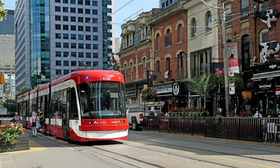
Toronto is one of the most gridlocked cities in Canada. Last year the average driver lost about 100 hours (more than four full days) sitting in traffic. Here’s what City Hall won’t say out loud: we already own the fastest way to move people, and we let it crawl in traffic behind private cars.
Nearly 80 million streetcar rides last year, and four of the TTC’s five busiest surface routes are streetcars. One streetcar carries about 250 people; a bus carries 50 to 90. We don’t have a streetcar problem. We have a transit-trapped-in-traffic problem. Free, frequent, on-time transit is how we win riders back and cut gridlock.
Manage it, complain about it, or fix it
Olivia Chow manages congestion, her plan is literally called the “Congestion Management Plan.” Brad Bradford complains about it, with a slogan and light-rail promises that carry no rider until 2030. I’ll fix it. I’m an engineer: diagnose the real bottleneck and fix the flow. That’s the whole job.
Keep the TTC ours
The TTC must stay publicly owned and municipally governed: accountable to riders, not privatized, and not run by Queen’s Park or Metrolinx for local fare and service decisions. I will fight Bill 98 and any move that strips Toronto of final authority over fares, service, and operations. Local control is how we deliver free, reliable transit, not surrender the keys.
The plan
Clear the Lanes · RapidTO
Clear the Lanes means dedicated transit lanes and signal priority as a connected network, including RapidTO bus and streetcar corridors. Keep the streetcars and free them from traffic.
Streetcar reform, network-wide
Priority lanes, signal priority, accessible boarding, left-turn bans where they trap lines, and real enforcement against blockers. One streetcar moves ~250 people, trapping it in traffic is a policy failure.
Stop the blockers
One illegally-parked car freezes a whole line. Enforce it.
Slow zones & state of good repair
Eliminate subway slow zones with real state-of-good-repair funding, repair-first capital, not another study. More frequent service, not cuts.
Smart signals & hotspot surgery
Signals that respond to real traffic, on a published timeline. Right vehicle, right route, the numbers decide, not ideology.
Dig once
Coordinated construction and real lane-closure fees. Open a street, fix it, reopen it, once.
Free TTC, freeze, Fair Pass, students
My destination is a free, reliable TTC. Until full free transit is funded: a fare freeze, lower monthly/weekly caps, Fair Pass phase 3 for low-income riders, and partnerships with colleges and universities on student affordability. Free transit is a congestion plan, it gets people out of cars.
Accessibility that shows up
Fully fund the TTC’s 10-year wayfinding strategy; protect and expand door-to-door Wheel-Trans; prioritize curb clearing at Wheel-Trans, bus, and streetcar stops after snowstorms, pay for verified hours cleared, not standby theatre.
Safer TTC, care first
Expand Toronto Community Crisis Service (TCCS) across the TTC network; platform edge doors starting at busy stations like Bloor-Yonge; more staff visibility and lighting. Mental-health crisis response belongs with trained crisis workers.
Housing upstream of the TTC
Upstream housing and shelters so no one has to sleep on the TTC. Housing-first, supportive housing, and real options, the subway is not a shelter system.
How we pay for it
Tax the billionaires: press Queen’s Park and Ottawa for operating and capital dollars from wealth and corporate fair-share tools those governments can actually levy, so riders are not the cash cow. City tools I control: a commercial parking levy (a small daily charge on non-residential spaces), dedicated to getting the city moving, with no toll booths. Already used in New York, Montreal, Vancouver, Chicago and San Francisco. The numbers are in the funding table on the Money & Taxes page.
The bottom line
Chow manages congestion. Bradford complains about it. I’ll end it: by getting transit out of traffic, keeping local control of the TTC, and funding service so fares aren’t the plan.
Let’s get Toronto moving.
Dr. Bahira Abdulsalam, PhD, P.Eng. · Founder, Be The Change Movement · bahira.ca
The Gardiner is not for sale
Under the 2023 Ontario-Toronto New Deal, the Gardiner and the Don Valley Parkway are set to transfer to the province in fall 2027. Toronto built them, Toronto paid for them, and Torontonians drive them every day. Once the province owns them, their repairs and closures are decided by a government Toronto cannot vote out.
City Hall delivers: I will use every step the city still controls in the transfer to keep both highways Toronto’s, and repair them on an engineer’s schedule, with condition data deciding the order.
I’ll fight for: a renegotiated New Deal that gives Toronto fair funding without giving up control. The transfer is a signed agreement, so undoing it needs the province. I won’t pretend a mayor can do it alone.
Our roads, our transit, our traffic, our call.
Fix what we have [City Hall delivers]
I’m an engineer, so I’ll start where the honesty starts: Toronto faces roughly an $18 billion 10-year state-of-good-repair funding gap (2025-2034): the City’s own Asset Management Plan gap versus the capital plan. Most of that pressure is transit and Toronto Community Housing, with about $2 billion on the road network and more on city facilities. Every year we defer maintenance, the bill grows and the risk rises. A city that can’t take care of what it already has hasn’t earned the right to announce anything new.
Deliver: a repair-first capital plan, fix and maintain what we own before announcing anything new, with condition data and engineering priority setting the schedule instead of the political calendar.
Run the network as one system [City Hall delivers]
You cannot fix traffic on a road you don’t control, and you cannot manage traffic one project at a time. Today the decisions about road work, transit construction, lane closures and detours are scattered across Transportation Services, the TTC, utility and watermain crews and private contractors that don’t coordinate. That fragmentation is the congestion problem.
Deliver: one coordinating authority over road and transit construction citywide, so corridors aren’t all torn up at once, detours are planned around real neighbourhoods, and the Gardiner and DVP are never fully disrupted in the same week. Not a new layer of bureaucracy, one accountable hand on a wheel too many people are grabbing at once.
Deliver: manage the space that clogs the core with a modest levy on large commercial parking lots, eases congestion where it’s worst and raises real money. It is dedicated to transit, and the numbers are on the Money & Taxes page. This is not a toll on your commute.
Deliver: keep freight and deliveries moving with smarter loading rules, so a double-parked truck doesn’t shut a lane at rush hour.
Advocate: coordinate with provincial transit. Metrolinx and subway expansion, so the whole network is planned as one.
Streets that move, and keep people alive [City Hall delivers]
A street works when everyone on it gets home safely: the driver, the cyclist, the child walking to school, the senior crossing with a cane.
Deliver: a real Vision Zero effort at the intersections and corridors where people are actually being hurt, not a plan on a shelf.
Deliver: the basics that get ignored, accessible sidewalks and curb cuts, reliable sidewalk snow clearing, Seniors Safety Zones.
Deliver: a safe, connected cycling network. In August 2026 the Court of Appeal overturned the ruling that protected the Bloor, Yonge and University lanes, and the province has moved to remove them. I’ll keep fighting for those lanes, and I’ll build protected lanes during road and watermain work that is already scheduled, using our own crews.
Fair pay and protection for the drivers who move us [City Hall delivers]
About 80,400 licensed private transportation company (Uber/Lyft) drivers were on Toronto’s books as of December 1, 2024. Too many tell the same story: a growing, opaque cut taken by the app; deactivation with no cause and no appeal; no pay for the time spent waiting and driving to pickups. Taxi and delivery work sit alongside this, and they deserve a fair floor too under the city’s Vehicle-for-Hire rules.
Deliver: use Toronto’s Vehicle-for-Hire licence to require full fare and commission transparency, deactivation protection (written cause, notice, a right of appeal), and a fair-earnings floor on the New York model, with a real voice for drivers in the rules that govern them.
Advocate: full employment rights (overtime, vacation, EI and CPP) which are a provincial and federal matter.
Snow cleared by the hour, by our own crews
Toronto’s winter contracts pay outside companies daily standby rates, whether a plow clears your street or not. Like New York, I’ll hire seasonal city crews and local workers directly, by the hour, when a storm hits, at published rates with verified hours. You pay for snow cleared, not for waiting, and the jobs stay local.
Parking & traffic tickets
Fair tickets, not a cash grab
Tickets should keep people safe and keep streets clear, not quietly pad a budget. As mayor, I’ll reform what City Hall controls, and press Queen’s Park hard on what it doesn’t.
City Hall, parking tickets
Most parking tickets are a City Hall file. I’ll reform so penalties are fair, the rules are clear, and disputes and payment are workable, not a maze designed to wear people down. Enforcement should focus on real safety and access problems: hydrants, accessible spots, and blocking transit or bike lanes, not gotcha revenue.
Queen’s Park, moving & traffic tickets
Speeding, red-light, and most other moving tickets sit under the provincial Highway Traffic Act. A mayor can’t rewrite the fine schedule alone, but I will press Queen’s Park for fair fine schedules. The city still influences camera programs and enforcement priorities, and I’ll use that leverage so safety comes first, not a cash grab.
City Hall, buildings & parking that actually works
I’ll require buildings to meet real standards for parking spots: proper dimensions, accessible parking that actually works, and no fake or inadequate spots that only look fine on paper.
City Hall delivers parking bylaws, enforcement priorities, disputes/payment systems, and building parking standards. I’ll fight at Queen’s Park for fair HTA fine schedules, and use every city lever on cameras and priorities in the meantime.
Engineer’s approach to congestion
Partner with traffic-innovation institutions
Toronto already has world-class traffic research sitting next door to City Hall. As mayor, I’ll partner with those institutions so proven tools get onto our streets, not stuck in papers and pilots.
Who I’ll work with: the University of Toronto Transportation Research Institute (UTTRI) and its ITS Centre and Testbed; Toronto Metropolitan University and other Ontario universities doing intelligent-transportation work; ITS Canada and applied tech partners; and City Transportation Services / TTC so operations and research stay in the same room.
- Scale adaptive and AI signal control that’s already been tested with the City of Toronto
- Use evidence (delay, safety, transit reliability) before locking in corridor changes
- Train city staff and keep a standing innovation pipeline, not one-off pilots that die
- Keep public data and privacy standards clear when sensors and cameras support the network
City Hall delivers the partnership agenda, signal network, and deployment budget. These institutions advise and co-develop, they don’t run the city. Naming them is not an endorsement of this campaign.

