Opinion
Why an Engineer Is Running for Mayor


When people ask me why an engineer would run for mayor, I tell them the question has it backwards. The better question is why we have gone so long without one.
Engineering is often misunderstood as a profession about things: beams and bridges, concrete and steel. It is not. At its heart, engineering is a profession about people. The first duty every professional engineer accepts, before we design anything at all, is to hold paramount the safety, health and welfare of the public. Not the client. Not the budget. Not the person paying the invoice. The public. That obligation is not a slogan we choose; it is the condition of holding the license, and a regulator exists to enforce it. When I signed for that responsibility, I was promising strangers I would never meet that I would put their wellbeing first.
In Canada, engineers carry a small, plain reminder of that promise. Many of us wear an iron ring on the working hand, a modest band that catches the edge of the page every time we write, so that the obligation is felt, not just remembered. The ring was born out of humility, out of the hard understanding that when engineers get it wrong, people are harmed, and that there is no rhetoric on earth that will hold up a structure that was badly designed. Reality does not negotiate. A beam either carries the load or it does not. You cannot argue a bridge into standing.
Reality does not negotiate. A beam either carries the load or it does not. You cannot argue a bridge into standing.
That is the discipline I want to bring to City Hall, because a city is the largest and most human piece of engineering there is. Toronto is roads and transit and water mains and housing, but it is also the single mother deciding between rent and groceries, the senior who cannot climb the stairs to a station with no elevator, the family in a shelter, the worker whose commute steals two hours from their children every day. Governing this city well is, at its core, an act of safeguarding the public. It asks exactly the questions an engineer is trained to ask: Who bears the load? Where will this fail? Who did we forget to design for?
Engineering ethics is not a side interest of my candidacy. It is the whole foundation of it, and it comes down to four habits I have practiced my entire professional life.
The first is that evidence outranks ideology. In engineering you are not entitled to your own facts. The calculation is the calculation, and if it says your design is unsafe, your confidence is irrelevant. Our politics too often runs the other way: the loudest claim wins, and being right matters less than sounding certain. I want a City Hall where decisions are made from evidence, where we measure what we do and change course when the numbers tell us to.
The second is accountability, including the honesty to name failure. When a structure fails, engineers do not spin it. We investigate. We publish what went wrong. We redesign so it never happens again. Toronto has real failures in housing, in homelessness, in affordability, in the daily dignity of getting across the city. Residents do not need those failures explained away. They need them owned, and then fixed.
The third is that you build for everyone, and you design for the person with the least. Good engineering does not serve the average user; it serves the most vulnerable one: the child, the person using a wheelchair, the elder. A curb cut designed for a wheelchair helps the parent with a stroller and the worker with a hand truck. That is my test for every decision a city makes: does it work for the person who has the least? If it works for them, it works for all of us.
The fourth is that you build to last. Engineers think in decades, not in election cycles. We design for the generation that will inherit what we leave behind. A city led that way stops making the cheap short-term choice that becomes the expensive long-term crisis and starts building the transit, the housing and the resilience our children will actually need.
This is why I believe we need more engineers, and more builders of every kind, in our politics, not fewer. There is a line I have carried through this campaign: you cannot ask the architect of a problem to solve it. Our public life is crowded with people skilled at describing problems and assigning blame. It is short of people trained to solve them: people who think in systems and trade-offs and consequences, who are comfortable being told they are wrong, and who treat public service not as a stepping stone but as a duty they are sworn to. Engineers are those people. So are nurses, teachers, tradespeople and small-business owners, the people who actually keep a city standing. Politics has been left too long to those who talk about the city. It belongs to the people who build it.
I am not a career politician, and I am not pretending to be. I am a structural engineer, a researcher and a teacher, a woman who built a career in a field that was not designed with her in mind, and who learned in the process that the strongest structures are the ones designed to hold up everyone. I am running because I believe the discipline that keeps a bridge from falling can keep a city from failing its people: evidence over noise, accountability over spin, design that includes everyone, and the patience to build for the long term.
That is what engineering means to me. It is not about concrete. It is about a promise to the public, the same promise I have kept my whole career, now offered to this city.
Be the change. Transform the city. People lead the government, and the government serves the people.
That is the Toronto I want to help build. And it is why an engineer is running for mayor.
Toronto needs an engineer. Vote Bahira.
On October 26, vote Bahira Abdulsalam for Mayor of Toronto.
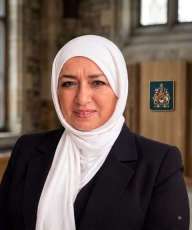
Dr. Bahira Abdulsalam, PhD, P.Eng., Candidate for Mayor of Toronto in the 2026 election, Founder, Be The Change Movement, bahira.ca
Volunteer with us → | (647) 785-3729 | bethechangeno1@gmail.com

