Opinion
A Quarter of Toronto Was Undecided. This Is for Them.
A quarter of voters hadn’t decided. That is the real story of this election.
In September, CBC Toronto’s This is Toronto, hosted by Chris Glover, asked a good question: what is this mayoral election really about? Three experienced city hall reporters answered it: Mahdis Habibinia of the Toronto Star, Aidan Chamandy of Toronto Today, and Matt Elliott, who writes City Hall Watcher. They spent most of the episode on two names.
The race, they said, was shaping up as a contest between the incumbent and a councillor, with the same priorities and different approaches. Then, almost in passing, the panel mentioned that roughly a quarter of voters were still undecided.
That number deserves more than a passing mention. Roughly one in four Torontonians looked at the choices they’d been told were the only real ones and said: not yet. They aren’t confused. They aren’t disengaged. They’re waiting for someone to speak to their lives.
Who decides who is “serious”?
Voters don’t decide in a vacuum. Long before anyone casts a ballot, the city is told who the serious candidates are: whose faces appear on the evening news, who gets booked for interviews, whose names are said aloud on panels like this one.
Every time a race is called a two-horse contest, it becomes a little more of one. People hear it, believe there’s no alternative, and vote against the candidate they fear instead of for the city they want. Then the result gets called the will of the voters.
I don’t blame the reporters on that panel. They cover city hall well, and they described the race the way it usually gets covered. But a city of three million people deserves a wider conversation than two names.
A vote for me is not a vote for anyone else. It is a vote for a different way of running this city.
The panel named the right issues. Here are real answers.
The panel was right about what matters: affordability, transit, congestion and public safety. Every candidate names them. The question is who has a plan built on what a mayor can actually deliver. You cannot ask the architect of a problem to solve it.
I am a structural engineer, not a career politician. Here is what I will do.
- Affordability. A one-year freeze on residential property taxes, followed by work toward property taxes geared to income. Public land kept public, with homes people can own built on top of it through community land trusts. A fair deal for tenants: a crackdown on bad landlords, an end to unfair evictions, and a fight at Queen’s Park to restore rent control and bring rents down. (Housing plan)
- Transit and congestion. A fare-free TTC, phased in so every stage is funded before it starts, until it’s free for everyone. This city needs to flow, and the billionaire class should pay its fair share to make that happen. Free transit gets cars off the road and gets workers to their jobs. (Transit plan)
- Public safety. I will take the mayor’s seat on the Toronto Police Service Board myself, rather than hand it to someone else. I will invest in what prevents harm: youth programs, jobs and violence interruption. (Safety plan)
- Fix what we have. Toronto faces a repair backlog of roughly $18 billion. I will bring an engineer’s discipline to it: honest multi-year budgets, independent reviews before big projects get more money, and no more blank cheques. (Money & Taxes)
My full plan is at bahira.ca. It keeps what a mayor can deliver separate from what a mayor has to fight for at Queen’s Park and in Ottawa.
Scarborough is not a battleground
CBC’s This is Toronto gave Scarborough a whole episode, and rightly so. It helped decide the last election, and every campaign knows it can decide this one. But every four years Scarborough gets talked about as territory to win. Between elections, it waits: for transit, for investment, for someone to listen.
Scarborough deserves transit that shows up and local jobs. It deserves neighbourhood incubators that turn empty storefronts and unused city buildings into space for local entrepreneurs, newcomers and young people.
It also deserves a real say over what is built there. A hyperscale data centre is proposed in Scarborough, and thousands of residents have asked the city to pause before approving it. I agree with them. No major project should go ahead in any community until that community has been consulted first, in plain language, on a real timeline, with a public report on what was heard.
I won’t run on fear
There’s an honest observation to make about social media: the algorithm rewards a story of a city that is dangerous and falling apart, and candidates are tempted to feed it.
I won’t. Toronto is not broken. It has been badly managed, and those are different problems with different solutions. A broken city needs a saviour. A badly managed city needs someone who knows how to plan, build and account for every dollar.
Fear wins clicks, but it doesn’t fix a single watermain, house a single family, or make a single street safer. Plans do.
So what is this election really about?
It’s about whether Toronto keeps choosing between the options it’s handed, or chooses for itself. It’s about whether the undecided get written off, or get a reason to show up.
Toronto will no longer throw its people away. It will be the place that takes care of its people, and I will change the rules of the game.
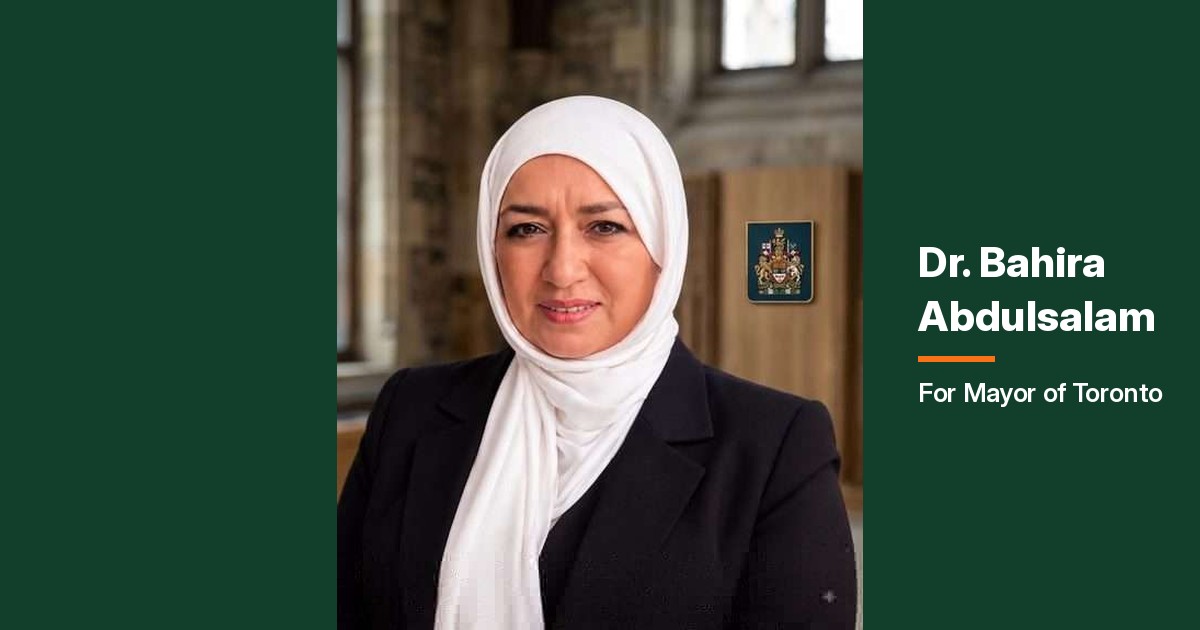
I am No. 2 on the ballot. Election day is Monday, October 26. Read the plan, ask me anything, and decide for yourself at bahira.ca.
Dr. Bahira Abdulsalam, PhD, P.Eng.
Candidate for Mayor of Toronto.
Founder, Be The Change Movement.
People lead the government. Government serves the people. Let’s engineer our solutions.


Leave a Reply