Article
Toronto Votes for Decline
The numbers behind the headline
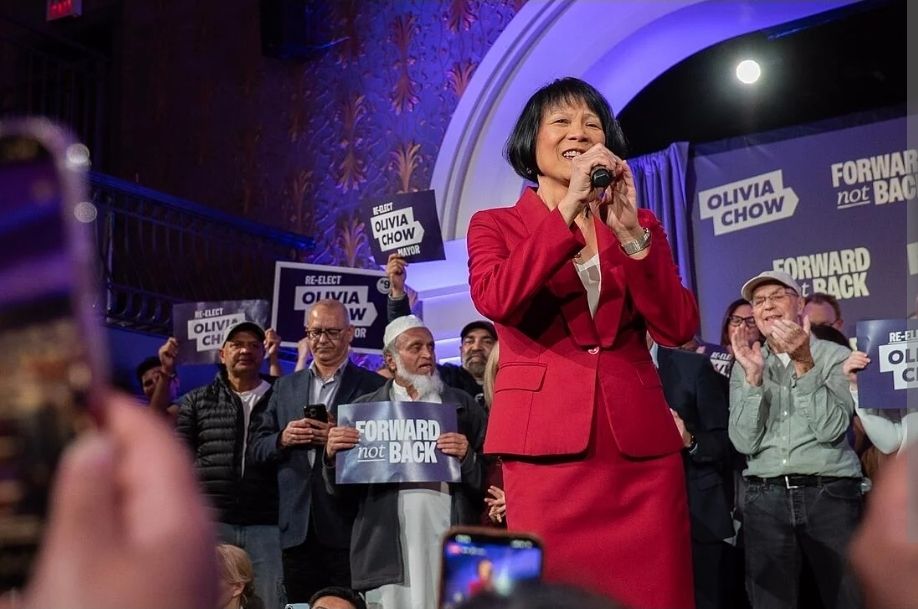
Olivia Chow won on Monday. But a record vote total is not the same thing as a mandate, and the next four years will go better if City Hall reads the result honestly.
Chow took roughly 530,000 votes, the most of any mayoral candidate since amalgamation (CBC). Her share, about 54%, is the lowest of any re-elected Toronto mayor (Global News; The Local). Brad Bradford, who won barely 1% citywide in 2023, drew around 400,000 votes and 41%.
That is not a city that has settled the question. Two in five voters went to the polls to replace the incumbent, and one week before election day the polls showed a tie (CP24). A mayor who treats that as an endorsement of everything since 2023 will have misread her own city.
Taxes timed for the ballot box
Under Chow, property taxes rose 9.5% in 2024, the largest increase since amalgamation. They rose another 6.9% in 2025. Compounded with 2026, that is close to 20% in three budgets (CBC; CP24 / CTV).
Then came the election year, and the increase fell to 2.2%. The city did not suddenly become cheaper to run. The operating budget grew from about $16.2 billion in 2023 to $18.9 billion in 2026, an increase of roughly $2.7 billion (CBC).
The mayor credits luxury-home and vacant-home taxes for the smaller hike. Those are reasonable tools. But a tax path that peaks early and dips in the year voters decide is a political calendar, not a financial plan. Toronto deserves multi-year budgets that tell residents in advance what is coming.
More money, the same repairs left undone
The test of higher taxes is whether the things residents depend on got better. On the city’s own housing, the answer is no.
In July 2026 the Auditor General reported that more than half of Toronto Community Housing developments were in poor or critical condition in 2024. TCHC needs about $4.5 billion in repairs from 2026 to 2035 and has about $1.5 billion planned (CBC). More than half of its repair budget comes from federal money that ends after 2027.
As recently as 2023, TCHC said its portfolio would reach a sustainable state of good repair by 2026. That year has arrived, and tens of thousands of tenants live with the gap. Before City Hall promises thousands of new homes, it should show it can maintain the homes it already owns.
I say this as a structural engineer who has spent a career on rehabilitating ageing infrastructure. Fixing what we have is the cheapest housing policy there is, and it is the one this administration has deferred.
A mayor the Premier is happy with
In 2023, Doug Ford warned that a Chow victory would be an “unmitigated disaster” (Globe and Mail). By 2026 he was telling reporters he really liked the mayor, and in September he urged voters to “read between the lines” (CBC).
That warmth was earned. In the November 2023 New Deal, Toronto handed the Gardiner Expressway and the Don Valley Parkway to the province. In exchange it got financial relief, and it dropped its opposition to the Ontario Place redevelopment, which Chow had campaigned to stop (CBC). The deal also ended her promise to replace the eastern Gardiner with a ground-level boulevard (Globe and Mail).
A working relationship with Queen’s Park matters. But a mayor’s job is to bargain hard for Toronto, not to be the partner the Premier finds easiest to work with. When the province praises the city’s mayor in the middle of her campaign, residents are entitled to ask who got the better side of the bargain.
A city that narrowed the right to be heard
In May 2025, council passed the “bubble zone” bylaw 16 to 9, with the mayor voting in favour (City of Toronto; CBC). Places of worship, schools and child-care centres can now apply for a 50-metre zone where protest is restricted, for up to a year, with fines of up to $5,000 (CityNews).
Every resident deserves to reach a place of worship or a daycare without harassment. Toronto already has laws against harassment, intimidation, threats and blocking an entrance. The bylaw goes further and restricts lawful, peaceful expression in public space, and critics warned from the start that it may not survive a Charter challenge (The Grind).
Bradford supported the bylaw too (The CJN), so this was never a contest between the two front-runners. That is exactly the point. On the question of whether Torontonians may still speak freely on their own streets, voters were offered no choice at the top of the ballot.
Decline is a choice, and it can be reversed
On Monday Toronto chose continuity: higher spending, election-timed taxes, deferred repairs and a comfortable arrangement with Queen’s Park. That is a vote for managed decline, even if few who cast it saw it that way.
It does not have to stay that way. Over the next four years, residents and councillors should hold City Hall to four tests:
- Multi-year budgets. Publish the tax path for the full term now, not one year at a time.
- Repair first. Close the TCHC repair gap and report progress building by building.
- Independent accountability. Give the Auditor General a mandate over every major project, with public cost-to-complete reporting.
- Rights intact. Review the bubble-zone bylaw against the Charter before a court does it for us.
The 400,000 people who voted for change did not disappear on Tuesday morning, and neither did the many who voted for other candidates. Toronto is not finished. It is waiting for leadership that fixes what we have and answers for results.
Dr. Bahira Abdulsalam, PhD, P.Eng., is a structural engineer and was an independent candidate for Mayor of Toronto in 2026.
The case on the other side
These are the strongest replies Chow’s supporters will make. Expect them and be ready to answer them.
- The mandate is real. She won 19 of 25 wards and more votes than any mayor since amalgamation, beating Bradford by roughly 125,000.
- The tax hikes paid for an inherited hole. She took office facing a deficit of about $1.8 billion, and the 2024 budget funded police, transit and warming centres.
- Spending growth is partly federal and provincial money. In 2025, about 45% of the new operating spending came from other governments.
- The New Deal helped the city. The Gardiner and DVP upload removed the city’s largest repair liability and frees about $1.9 billion over the decade.
- The TCHC gap is a funding problem across governments. The province’s current repair contribution covers only a small share of the units in poor condition.
- The bubble-zone bylaw protects worshippers and children. Supporters say it answers real harassment at synagogues and schools, and both leading candidates backed it.
Sources
- Global News: Chow re-elected and The Local: 54.16% vs 41.11%, 19 of 25 wards
- CBC: about 530,000 vs 404,000 votes
- CP24: Liaison / pre-election poll shows statistical tie
- CTV / CP24: 2026 budget at 2.2% after 6.9% and 9.5%
- CTV / CBC: operating budget $16.16B to $18.9B
- CBC: 2025 budget and federal/provincial share
- Toronto Auditor General: TCHC building repair audit and Future of Good / CBC: $4.5B need vs $1.5B planned
- TCHC budget backgrounder: on track for 2026
- CTV 2023: Ford’s “unmitigated disaster”, CP24: Ford on Chow’s re-election bid, NOW / CBC: “read between the lines”
- Globe and Mail: New Deal and the eastern Gardiner, CBC: Ontario Place concession, City of Toronto: Gardiner/DVP transfer
- The CJN: bubble-zone vote 16 to 9, CTV / CBC: Bradford’s support, The Grind: fines and Charter concerns
- Toronto Sun: Brian Lilley column, Oct 27, 2026 (“Toronto hits the snooze button, gives Chow four more years”)
Fix What We Have. Answer for Results.
Stand with our independent movement for multi-year budgets, state-of-good-repair housing, independent accountability, and Charter rights in Toronto.

Dr. Bahira Abdulsalam, PhD, P.Eng.
Founder, Be The Change Movement
bahira.ca
Volunteer with us → | (647) 785-3729 | bethechangeno1@gmail.com

