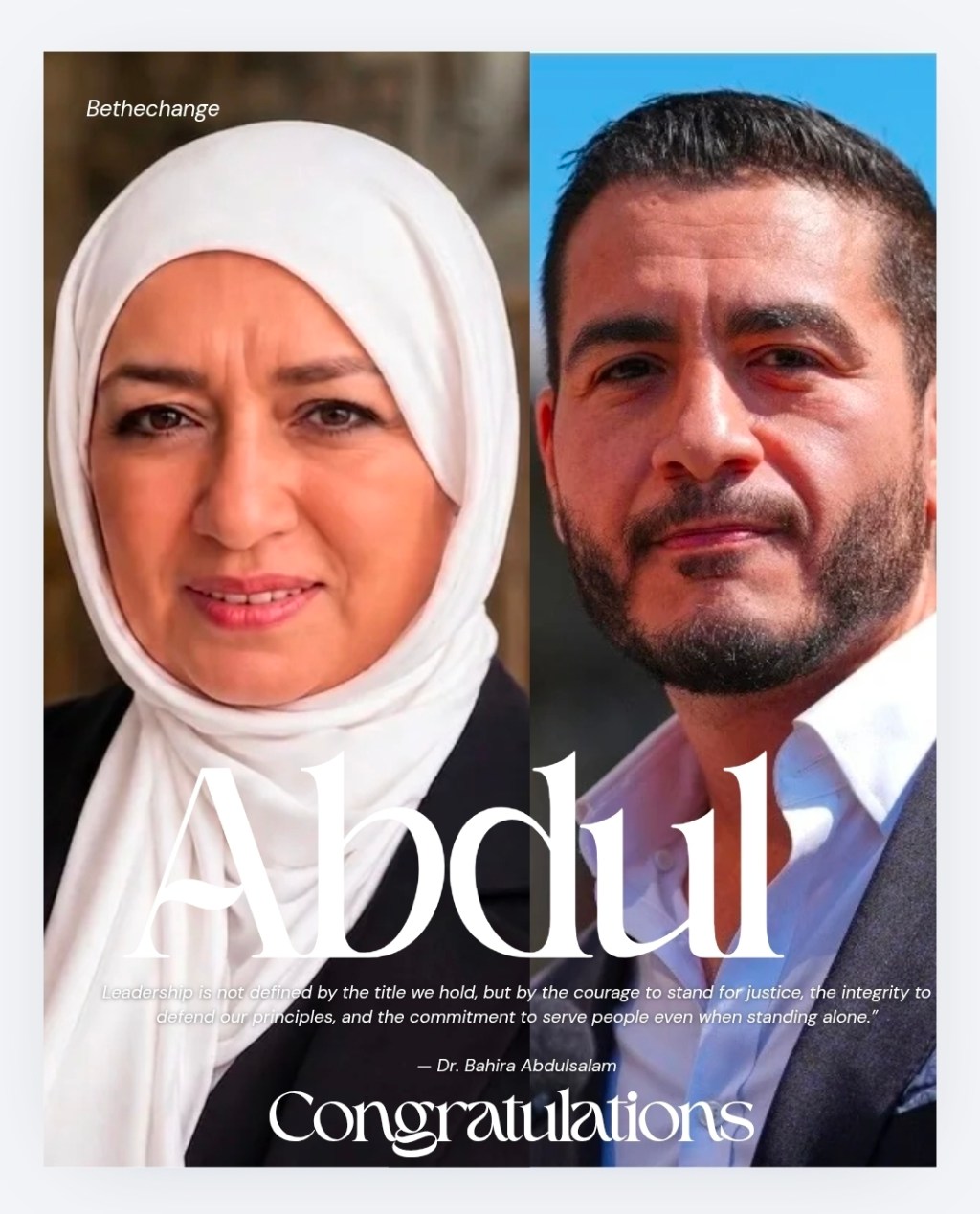
By Dr. Bahira Abdulsalam, PhD, P.Eng.
Michigan has made history. In the early hours of November 4, 2026, the Associated Press called Michigan’s U.S. Senate race for Abdul El-Sayed, physician, public health leader and son of Egyptian immigrants. He defeated Republican Mike Rogers with about 52% of the vote, and he will be the first Muslim American ever to serve in the United States Senate.
This is a new beginning, and a transformation in American political history.
One of the most beautiful moments of this campaign came from his wife, Dr. Sarah Jukaku, a Muslim woman in hijab and a practising physician. On the eve of the election, she gave him the most powerful introduction of his campaign. Standing before a Detroit crowd, she said with pride: “It’s my great honor and privilege to introduce my husband and the next U.S. senator from the great state of Michigan, Dr. Abdul El-Sayed.” Hours later, they embraced on stage as he declared, “Michigan, we did it!”
That moment touched me deeply. I know what it means to stand in front of the public in hijab and ask for trust. When I ran for Mayor of Toronto this fall, I was a Muslim woman in hijab, an engineer and a PhD, on a ballot of 53 candidates. Some people looked at my scarf before they looked at my record. Too often, women like us are told that our hijab is a barrier to leadership, that we must choose between our faith and a seat at the table.
Dr. Jukaku’s moment on that stage answered that lie. A hijabi woman, a doctor, standing at the centre of American political history, not at its edges. Her hijab was not a barrier. It was a symbol of faith, carried with dignity into one of the most powerful rooms in the world.
To every young Muslim girl who watched that stage, and to every woman who has been told to take off her scarf to be taken seriously: you belong here, faith and all. My hijab, like hers, is a symbol of faith. It is not something to hide. It can stand in any room, on any stage, in any chamber of power.
For generations, Muslim Americans were told to wait their turn, to stay quiet, to be grateful for a seat at the back of the room. Abdul El-Sayed refused that bargain. He did not hide his faith, and he did not water down his values. He ran on health care, affordability and dignity for working families, and he took that message to every corner of Michigan, even when he was outspent and attacked for his name and his faith.
As he told voters: “My name and my faith are not the reason you can’t afford your groceries.”
Abdul El-Sayed’s victory did not come from a vacuum. The genocide in Gaza, the unlawful oppression of the Palestinian people, and the state violence of the Israeli government opened the eyes of millions of Americans to how their tax dollars fund weapons sent to Israel. More and more voters decided they no longer want their money used to kill innocent people. Michigan sent that message clearly: Americans want their government to invest in health care, schools and families at home, not in bombs abroad.
AIPAC and its allies spent, by his count, $42 million to stop Abdul El-Sayed, more than $30 million in the primary alone, and then millions more to help his Republican opponent. It failed. As he told the crowd on victory night: “To AIPAC, who spent $42 million against us: thank you for giving me the opportunity to beat you twice.” When the most powerful pro-Israel lobby in America pours record sums into one race and still loses, it signals the beginning of the end of AIPAC’s grip on American politics. Money can buy ads. It cannot buy the conscience of voters.
This is a victory for Palestine, too. Michigan has sent a senator to Washington who refused to stay silent on Gaza, was targeted for it with record lobby money, and won anyway.
His victory proves what many of us have long believed. Leadership is not defined by the title we hold, but by the courage to stand for justice, the integrity to defend our principles, and the commitment to serve people even when standing alone.
It also proves something about voters. When a candidate is informed, unafraid and engaged, people respond to the substance, not the labels others try to attach. Fear campaigns lose their power when a leader stays rooted in service.
To Muslim communities in Canada and around the world, this is not just good news from across the border. It is a lesson. Real power is not handed to us. It is built by developing our own leaders, organizing our own communities and earning the trust of the whole public, not just our own.
Michigan’s message reaches far beyond one Senate seat. In my view, it is a sign that the Trump era is coming to an end. Voters rejected fear and division and chose a leader who puts people first. It is also the rise of a new American leader, one who may one day serve as President of the United States.
And now, Canada: learn the lesson. Change is coming. The wave that swept Michigan is crossing the border, and it is going to reach you. Voters here are watching, organizing and ready to reward leaders who are genuinely there to serve their people, not those who change their costumes for every occasion, wear a different mask for every crowd, and use our tax dollars to sit on top of our cities and councils.
To Senator-elect Abdul El-Sayed: congratulations. You carry the hopes of millions who have never seen themselves in that chamber. We wish you strength, wisdom and courage in the work ahead.
Dr. Bahira Abdulsalam, PhD, P.Eng.
Founder, Be The Change Movement · bahira.ca


Leave a Reply